Petro Shine The Place for Oil and Gas Professionals.
Related Articles

Assignment Seismic Methods
Assess Data and Monitor Production
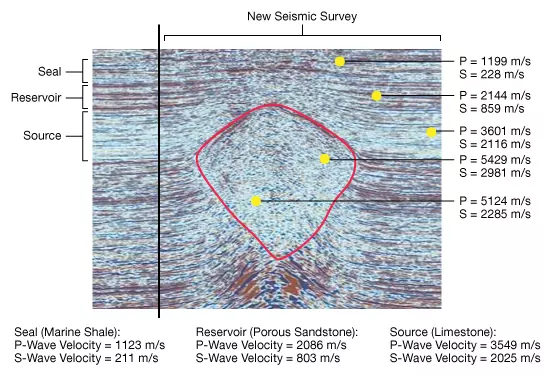
You are assisting a production team to make a decision regarding how to move forward with producing a tight reservoir. There is new seismic data in an area adjacent to the existing field. It is thought that the current stratigraphic units would extend into the new area, however there is an anomaly within that area of interest that needs to be investigated.
Use the data provided to complete the challenge.
Data:
Observations and Existing Knowledge:
The p-wave and s-wave velocities of the reservoir and the units above and below the reservoir (the seal and the source) are known.
P-wave and s-wave values have been calculated for various points within the new seismic area as well as within the anomaly.
The table provided gives some average P-wave and S-wave velocities to aid in your interpretation.
| Parameters That Influence Seismic Velocity | |||||||
|---|---|---|---|---|---|---|---|
| Type of formation | P wave velocity (m/s) | S wave velocity (m/s) | Density (g/cm3) | ||||
| Scree, vegetal soil | 300-700 | 100-300 | 1.7-2.4 | ||||
| Dry sands | 400-1200 | 100-500 | 1.5-1.7 | ||||
| Wet sands | 1500-2000 | 400-600 | 1.9-2.1 | ||||
| Saturated shales and clays | 1100-2500 | 200-800 | 2.0-2.4 | ||||
| Marls | 2000-3000 | 750-1500 | 2.1-2.6 | ||||
| Saturated shale and sand sections | 1500-2200 | 500-750 | 2.1-2.4 | ||||
| Porous and saturated sandstones | 2000-3500 | 800-1800 | 2.1-2.4 | ||||
| Limestones | 3500-6000 | 2000-3300 | 2.4-2.7 | ||||
| Chalk | 2300-3600 | 1100-1300 | 1.8-3.1 | ||||
| Salt | 4500-5500 | 2500-3100 | 2.1-2.3 | ||||
| Dolomite | 3500-6500 | 1900-3600 | 2.5-2.9 | ||||
Based on the provided data, what is the probable interpretation of the subsurface material associated with the seismic anomaly?
Solution
The probable interpretation of the subsurface material associated with the seismic anomaly is salt. Salt has a very low density which allows the p-waves and s-waves to travel through it very fast compared to other formations such as sands and shales. Dolomite is close with respect to velocity, however, dolomite has a high enough density that when p-waves and s-waves pass through it, it behaves much like limestone.
Assessment Seismic Methods
1. When a pulse reaches a boundary target in reflection seismology, the energy __.
A .reflects back toward the surface
B .reflects along the boundary
C .diffracts downward and sideways
D .diffracts back toward the surface
2. Tomography is the act of gathering sections of what wave types? (Select all that apply.)
A .S-waves
B .Surface waves
C .Love waves
D .P-waves
3. Select the two classifications of seismic wave types. (Select all that apply.)
A .Velocity
B .Contracting
C .Body
D .Surface
E .Subterranean
4. Another term for microseismic technology is ________.
A .active seismic
B .passive seismic
C .seismography
D .refraction seismic
5. Where do microseismic movements originate from? (Select all that apply.)
A .Hydraulic fracturing events
B .Vibrator energy
C .Small earthquakes
D .Dynamite detonations
E .Shifting in the earth
6. How does energy move into surrounding rock or soil layers when it is refracted?
A .Horizontally
B .In circular motions
C .Vertically
D .Vertically and horizontally
Recommended for You
Introduction to Seismic Interpretation
Interpretation with Seismic Attributes