Petro Shine The Place for Oil and Gas Professionals.
Related Articles
Well Configurations
Horizontal drilling begins with a more-or-less vertical surface section (the one exception being slant drilling rigs, where this section is pre-inclined), followed by a bend section, which progresses from approximately 0° to 90° inclination with depth, and finally by a horizontal or lateral section. The transfer of weight to the drill bit during the horizontal drilling phase involves different concepts, which translate into different well configurations. We may generally distinguish these configurations, based on radius of curvature, as long turn radius, medium turn radius, short turn radius and ultra-short turn radius (Figure 1, Horizontal drilling methods):
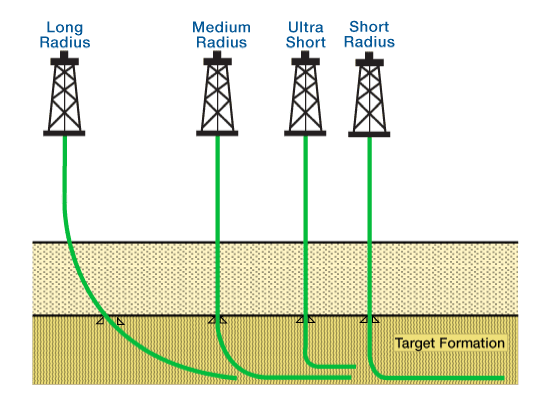
The considerations that enter into selecting one of these well configurations include
- cost
- well spacing and lease restrictions
- conditions of re-entry wells
- reservoir rock characteristics
- production methods
- well objectives
- problem-causing lithologies above the pay zone
- amount of total horizontal departure
- completion methods
- availability of specialized downhole tools
- kick-off depth constraints
- horizontal displacement constraints
Table 1 and Table 2, below, compare the basic characteristics of long, medium and short radius wells.
| Table 1: Comparative Characteristics of Horizontal Drilling Methods (Mitchell, 2006) | |||
|---|---|---|---|
| Long Radius | Medium Radius | Short Radius | |
| Build rate | |||
| Build radius (ft) | 1000 – 3000 | 160 – 1000 | 20 – 40 |
| Hole size (in) | No limits | ||
| Drilling Method | Rotary or steerable motor systems for curve and horizontal sections | Specially designed motors for angle build section; rotary or steerable motor systems for horizontal sections. | Specially designed deflection tools or articulated motors for angle build section; rotary tools and special drill pipe for horizontal sections. |
| Tubulars used | Conventional tubulars. | Heavy wall drill pipe for build rates of up to 15° per 100 ft; special service drill pipe for higher build rates. | Special articulated tubulars; special drill pipe with short articulated motors. |
| Drill bit | No limits | No limits | Rotary: No limits Motor: Diamond or PDC |
| Drilling fluids | No limits | >No limits | No limits |
| Surveying | No limits | MWD capabilities limited for hole sizes
smaller than |
Special |
| Coring | Conventional coring, no limits | Conventional coring, no limits | 3-foot core barrel, 1-inch diameter core |
| Table 2: Comparative Characteristics of Horizontal Wells (IADC/SPE) | |||
|---|---|---|---|
| Long Radius | Medium Radius | Short Radius | |
| Selective completion capabilities | Yes | Yes | No |
| Multiple pay zones | No | Yes | Yes |
| Artificial lift capabilities | All types | All types | Rod pumps in vertical portion |
| Workover capabilities | Yes | Yes | Yes |
| Typical productivity index increases in non-fractured zones | 3.5 | 2.5 | 2.5 |
| Typical productivity index increases in fractured zones | Depends on fracture distribution | ||
| Production enhancement ratio (horizontal/vertical well) | 6 | 7 | Varies widely; can be from 1 to 100 |
| Cost ratio (horizontal/vertical well) | 1.5 | ||